29 CFR 1926.1408, 1926.1417–1422, 1926.1425, 1926.1428; Subpart CC Appendix A; 29 CFR 1910.179–180; ASME B30.5-2025; ASME B30.2-2022
Crane Signal Person Awareness
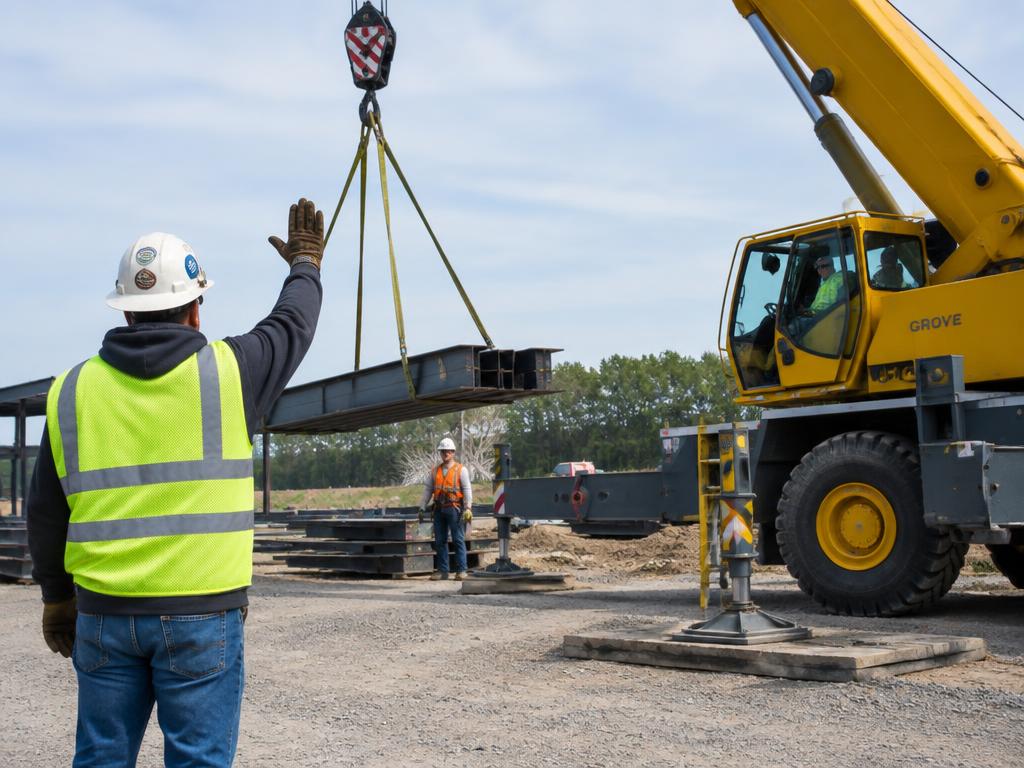
Long-form (about 60 minutes) signal person instruction: when signals are required, 1926.1428 qualification, the complete Standard Method and overhead crane hand signal charts, voice and radio protocols and handoffs, crane dynamics (radius, swing, deflection, side and shock loading, two-blocking, wind, ground), blind lifts and the fall zone, power-line clearances, spotters and contact response, multiple-crane lifts, and realistic field scenarios. Knowledge only — this course alone does not qualify a signal person; qualification requires oral/written and practical evaluation by a qualified evaluator, as 1926.1428 requires.
What's covered
- 1.Crane Signal Person
- 2.When a Signal Person Is Required
- 3.Signal Person Qualifications
- 4.Types of Signals
- 5.Standard Hand Signals — Hoist and Boom
- 6.Standard Hand Signals — Swing, Travel, Extend, Stop
- 7.Emergency Stop and Stop Signals
- 8.Voice and Radio Signals
- 9.Positioning and Load Awareness
- 10.Working with Riggers and the Lift Plan
- 11.Power Lines and Hazardous Conditions
- 12.Documentation and Responsibilities
- 13.Part 1: The Complete Hand Signal Chart
- 14.Hoisting Signals in Detail
- 15.Boom Signals in Detail
- 16.Swing, Travel, and Crawler Signals
- 17.Telescoping, Stop, and Hold Signals
- 18.Overhead and Gantry Crane Signals
- 19.Non-Standard Signals and Signal Practice
- 20.Part 2: Voice Signal Protocols
- 21.Radio Equipment and Channel Discipline
- 22.Continuous Talk-Down and Confirmation
- 23.Handoffs Between Signal Persons
- 24.Part 3: Crane Dynamics — Radius and Capacity
- 25.Swing Dynamics and Load Sway
- 26.Boom Deflection, Side Loading, and Shock Loading
- 27.Two-Blocking, Wind, and Ground Conditions
- 28.Part 4: Blind Lifts
- 29.Executing a Blind Lift
- 30.Working Near People and the Fall Zone
- 31.Part 5: Power-Line Hazards and Clearances
- 32.Encroachment Prevention and the Dedicated Spotter
- 33.Traveling Under Lines and Responding to Contact
- 34.Part 6: Multiple-Crane Lifts
- 35.Signaling a Multiple-Crane Lift
- 36.Part 7: Scenario — The Roof Unit Lift
- 37.Scenario — The Power Line Near the Laydown Yard
- 38.Scenario — Two People Signaling
- 39.Scenario — The Silent Radio
- 40.Scenario — The Load That Drifted Out
- 41.Scenario — Overhead Crane in a Busy Plant
- 42.Scenario — Weather Changes the Plan
- 43.Final Review: The Signal Person’s Checklist
- 44.Part 8: The Pre-Lift Meeting
- 45.Rigging Basics for Signal Persons
- 46.Visibility, Noise, and Language
- 47.Tower Cranes and Assembly Work
- 48.Hoisting Personnel
- 49.Scenario — Setting Pipe in an Excavation
- 50.Scenario — The Night Lift
- 51.Scenario — The Wrong Hook
- 52.Scenario — Pressure to Hurry
- 53.Part 9: Skills Drill — Calling a Complete Lift
Key takeaways
- A signal person is required when the operator cannot fully see the point of operation.
- Qualification requires a qualified evaluator, a written or oral test, and a practical test.
- Use the Standard Method hand signals in Appendix A.
- Anyone may give an emergency stop, and the operator must obey.
- Only one person signals at a time; stop if communication is lost.
- Voice signals: function and direction, distance or speed, then stop.
- Stay out of the fall zone and understand load swing and boom deflection.
- Power line spotters must be qualified signal persons with no other duties.
- Voice signals name the crane when more than one is operating; silence means stop.
- Hand off control formally with the load stopped; plan blind lifts before the crane moves.
- Multiple-crane lifts need a qualified person’s plan reviewed with everyone in a pre-lift meeting.
Every course includes
Professional narration, synced captions, a knowledge-check quiz, completion records, and certificates of completion for team learners. Works on phone, tablet, and computer.
This is awareness-level training only. It does not certify, qualify, or authorize anyone to perform work and does not by itself establish compliance. The employer is responsible for site-specific training, hands-on verification, and work authorization.